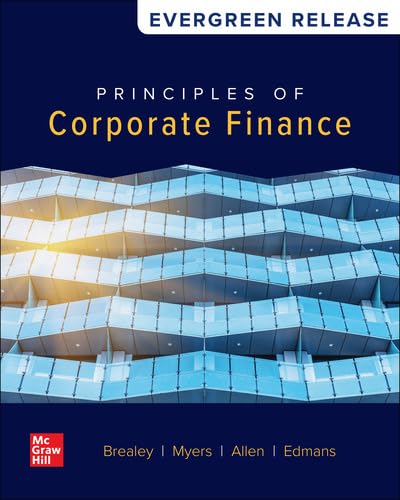
Principles of corporate finance / Richard A. Brealey, Emeritus Professor of Finance, London Business School, Stewart C. Myers, Emeritus Professor of Financial Economics, Sloan School of Management, Massachusetts Institute of Technology, Franklin Allen, Professor of Finance and Economics, Imperial College London, Alex Edmans, Professor of Finance, London Business School.
Publication details: New York, NY, McGraw Hill : 2025Edition: 2025 releaseISBN:- 9781266586156
- 658.15 23/eng/20250129
- HG4026 .B667 2025
| Item type | Current library | Collection | Call number | Copy number | Status | Barcode | |
|---|---|---|---|---|---|---|---|
 Books
Books
|
URBE Library General Stacks | Non-fiction | HG4026 .B667 2025 (Browse shelf(Opens below)) | c.1 | Available | 1034 | |
|
Books
|
URBE Library General Stacks | Non-fiction | HG4026 .B667 2025 (Browse shelf(Opens below)) | c.2 | Available | 1035 |
Browsing URBE Library shelves,Shelving location: General Stacks,Collection: Non-fiction Close shelf browser (Hides shelf browser)

|
|

|
|

|
|

|
||
| HG4026 .B667 2020 C.1 Principles of corporate finance / | HG4026 .B667 2020 C.2 Principles of corporate finance / | HG4026 .B667 2025 Principles of corporate finance / | HG4026 .B667 2025 Principles of corporate finance / | HG4026 .B669 2017 Copy 1 Financial management : | HG4026 .B669 2017 Copy 2 Financial management : | HG4026 .B6693 2022 C.1 Fundamentals of financial management / |
Includes index.
Previous editions ©2023, 2020, and 2017.
PART ONE: VALUE1. Introduction to Corporate Finance 2. How to Calculate Present Values 3. Valuing Bonds 4. Valuing Stocks 5. Net Present Value and Other Investment Criteria 6. Making Investment Decisions with the Net Present Value Rule PART TWO: RISK7. Introduction to Risk, Diversification, and Portfolio Selection 8. The Capital Asset Pricing Model 9. Risk and the Cost of Capital PART THREE: BEST PRACTICES IN CAPITAL BUDGETING 10. Project Analysis 11. How to Ensure That Projects Truly Have Positive NPVs PART FOUR: FINANCING DECISIONS AND MARKETING EFFICIENCY12. Efficient Markets and Behavioral Finance 13. An Overview of Corporate Financing 14. How Corporations Issue Securities PART FIVE: PAYOUT POLICY AND CAPITAL STRUCTURE15. Payout Policy 16. Does Debt Policy Matter? 17. How Much Should a Corporation Borrow? 18. Financing and Valuation PART SIX: CORPORATE OBJECTIVES AND GOVERNANCE19. Agency Problems and Corporate Governance 20. Stakeholder Capitalism and Responsible Business PART SEVEN: OPTIONS21. Understanding Options 22. Valuing Options 23. Real Options PART EIGHT: DEBT FINANCING 24. Credit Risk and the Value of Corporate Debt 25. The Many Different Kinds of Debt 26. Leasing PART NINE: RISK MANAGEMENT27. Managing Risk 28. International Financial Management PART TEN: FINANCIAL PLANNING AND WORKING CAPITAL MANAGEMENT29. Financial Analysis 30. Financial Planning 31. Working Capital Management PART ELEVEN: MERGERS, CORPORATE CONTROL, AND GOVERNANCE32. Mergers 33. Corporate Restructuring PART TWELVE: CONCLUSION34. Conclusion: What We Do and Do Not Know about Finance
"This book describes the theory and practice of corporate finance. It's clear why financial managers have to master the practical aspects of their job, but why do practitioners need to bother with theory? Managers learn from experience how to cope with routine problems. But the best managers are also able to respond to change and deal with non-routine situations. To do so you need more than rules of thumb and gut feel; you must understand why companies and financial markets behave the way they do. In other words, you need a theory of finance. That should not sound intimidating. Good theory helps you grasp what is going on in the world around you. It helps you ask the right questions when times change and new problems need to be analyzed. It also tells you which things you do not need to worry about. Throughout this book, we show how managers use financial theory to solve practical problems"-- Provided by publisher.
Ages 18+ McGraw Hill LLC
There are no comments on this title.
Click on an image to view it in the image viewer